
Switching website providers isn’t a small decision when your law firm has spent years building its reputation and attracting clients online.
Your FindLaw website may already bring in qualified inquiries, rank for valuable searches, and contain content you’ve invested in over time. You don’t want to put that progress at risk.
But perhaps your firm has outgrown its current website. The design no longer reflects your reputation, making changes feels restrictive, or you’re questioning how much control you actually have over your online presence.
And if you’ve considered leaving FindLaw, you may already be asking a more difficult question: What happens to everything we’ve built when the contract ends?
I believe that’s where the decision should begin.
You’re not simply shopping for another website provider. You’re deciding how your firm will manage one of its most important business assets over the next several years.
I’ll compare three FindLaw website alternatives worth considering: independent custom website development, Justia Elevate, and Scorpion. We’ll look at their strengths, limitations, costs, and what each means for your firm’s future.
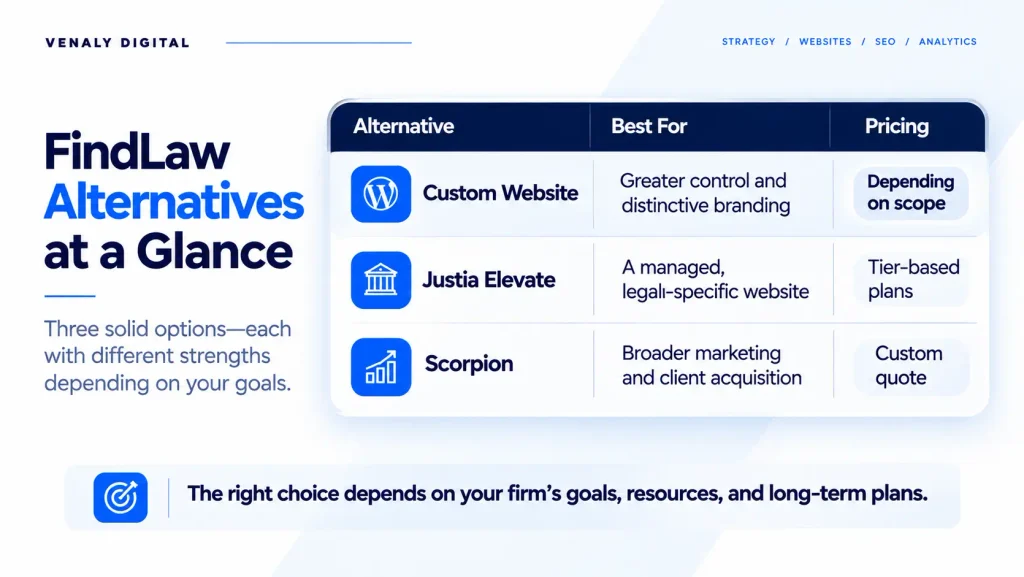
FindLaw Website Alternatives at a Glance
| Alternative | Best For | Pricing | Main Consideration |
|---|---|---|---|
| Independent Custom Website | Established firms seeking greater control and distinctive branding | Depending on the scope | Higher upfront investment |
| Justia Elevate | Firms wanting another legal-specific managed website | Tier-based plans; confirm current pricing | Service-plan limits and provider arrangements |
| Scorpion | Firms seeking broader marketing and client acquisition services | Custom quote | Ongoing services, contracts, and portability |
Each option solves a different problem.
Before comparing them, I’d examine why your current FindLaw arrangement may no longer fit your firm.
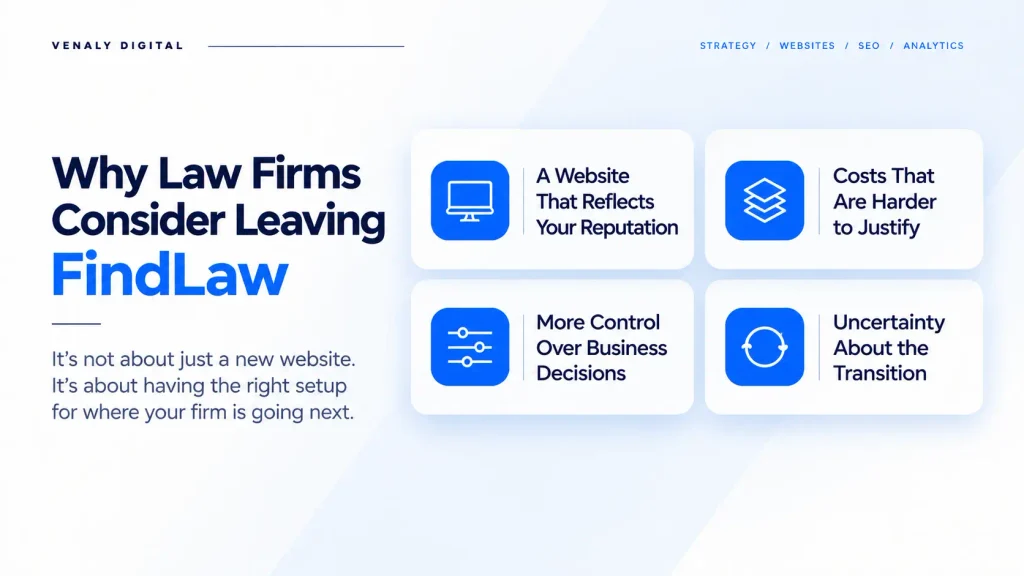
Why Law Firms Consider Leaving FindLaw
FindLaw offers the convenience of having a provider manage your website alongside other legal marketing services.
For many firms, that arrangement makes sense.
But convenience isn’t the same as flexibility. And as your practice grows, the distinction becomes more important.
Your website may no longer reflect your reputation
An established law firm has more to communicate than its practice areas and office address.
Your experience, the cases you handle, the attorneys behind the firm, and the reasons clients choose you should all be apparent when someone visits your website.
A prospective client considering a high-stakes legal matter isn’t simply looking for a lawyer who offers the right service. They’re deciding whom to trust.
That doesn’t require an elaborate design. It requires a website that presents your firm with clarity and authority.
If your current site looks interchangeable with competing practices, you may be missing an opportunity to distinguish the business you’ve spent years building.
I wouldn’t recommend redesigning a website just to make it look newer. I’d recommend it when the current experience no longer communicates the value of the firm behind it.
Your marketing costs are becoming harder to justify
FindLaw provides more than website development. Depending on your agreement, you may also be paying for SEO, content, advertising, directory visibility, or other services.
There’s nothing wrong with that if the results justify the investment.
The problem comes when you can’t clearly distinguish what you’re paying for from what generates business.
Are your qualified consultations coming from organic search, paid campaigns, directory listings, or referrals? Which services would you keep if they weren’t part of the same arrangement?
I’ve seen attorneys raise these concerns in discussions about FindLaw, particularly when monthly spending doesn’t appear to translate into meaningful business.
My recommendation is simple: evaluate the results before evaluating the price.
An expensive service that consistently produces profitable cases may be worth keeping. A cheaper one that doesn’t contribute to growth may not be.
You want more control over business decisions
Perhaps you’re expanding into a new practice area, hiring attorneys, or considering a different SEO partner.
You may also want to change your intake process, introduce new website features, or improve how inquiries are measured.
These shouldn’t automatically require reconsidering your entire website arrangement.
For me, this is one of the strongest reasons to explore alternatives.
Your ability to improve your firm’s digital presence shouldn’t depend entirely on remaining with the same provider.
The level of flexibility FindLaw offers depends on your services and agreement. But if your current setup makes ordinary business decisions unnecessarily complicated, it’s worth considering a different model.
You’re concerned about what happens if you leave
This is where the conversation becomes more serious.
Attorneys discussing FindLaw on Reddit have raised concerns about transferring their websites, retaining domains and email addresses, and dealing with complications during a provider change.
Others have reported being able to retain their content and complete a transition.
Those different experiences matter.
I wouldn’t assume FindLaw will prevent you from moving your assets. I also wouldn’t assume everything can be transferred without additional work.
Before making a decision, I’d want to know exactly what your firm controls, what the current agreement allows, and which parts of the website would need rebuilding.
That uncertainty shouldn’t prevent you from exploring alternatives. But it should influence how you approach the transition.
The 3 Best FindLaw Website Alternatives for Established Law Firms
Not every alternative gives your firm the same level of independence.
Some providers replace FindLaw’s managed service with another managed service. Others allow you to separate website ownership from ongoing marketing.
The right choice depends on whether your priority is convenience, stronger client acquisition, or greater control over your website.
1. Independent Custom Website Development
Best for established law firms seeking stronger branding, greater control, and long-term flexibility.
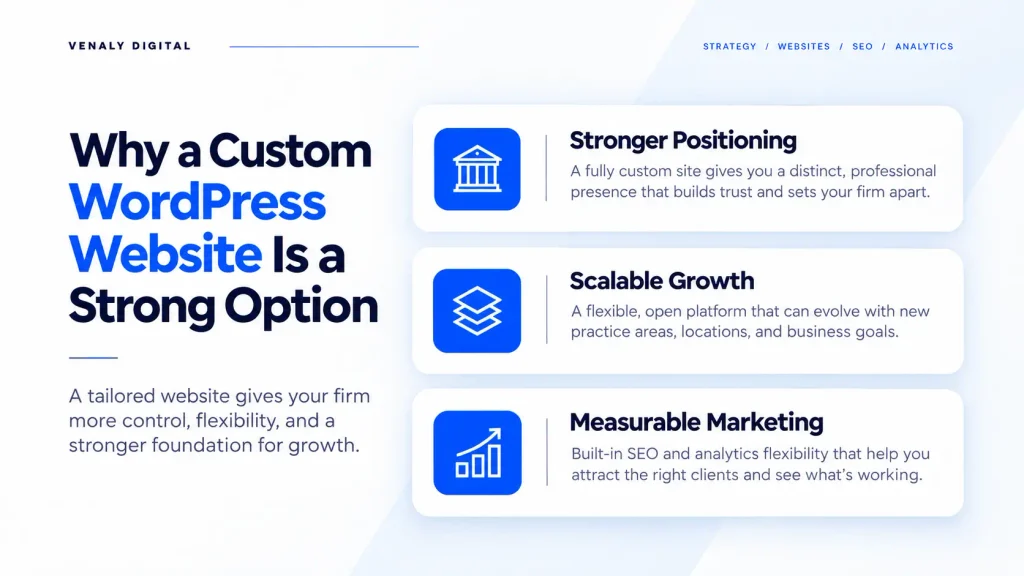
Rather than moving from FindLaw to another managed platform, your firm can commission a website developed specifically for its needs.
At Venaly Digital, we use WordPress for these projects.
FindLaw also uses WordPress for websites within its managed infrastructure, so the distinction isn’t the CMS itself. It’s how the website is designed, managed, and controlled.
A website built around your practice
A commercial litigation firm shouldn’t necessarily present itself like a personal injury practice.
Different clients have different expectations, concerns, and reasons for selecting legal representation.
Custom development allows your website to reflect those differences through its design, attorney profiles, practice-area structure, content, and consultation process.
It also gives you more flexibility as the firm grows.
If you’re adding attorneys, opening another office, or expanding into new services, your website should support those decisions without forcing your business into a predefined structure.
I also wouldn’t replace existing content simply because we’re building a new site. If certain pages already attract qualified visitors, preserving and improving them may be the smarter decision.
Control without taking on technical responsibilities
One concern I understand is that law firm owners don’t want to become website administrators.
You have a practice to run. Managing security updates, hosting, backups, and plugins shouldn’t become another responsibility on your desk.
And it doesn’t have to.
Your firm can control its website while a professional handles ongoing maintenance.
The important part is establishing clear ownership and access from the beginning.
I recommend documenting who controls the domain, hosting environment, website files, software licenses, and administrative accounts.
That gives your firm greater freedom to change providers later without unnecessarily rebuilding the entire website.
Independent website pricing
Our base offer includes the first year of hosting and three months of post-launch technical support. Additional development, ongoing maintenance, and marketing services are scoped separately.
A complex site with extensive content or integrations may require a larger investment.
The upfront cost is higher than many entry-level website subscriptions. However, an independent website gives you the option to choose who maintains it, who improves it, and which marketing services you purchase.
My assessment: I’d consider this the strongest fit for an established firm that wants its website to better reflect its reputation while gaining control over future decisions. The trade-off is the upfront investment and the need for a reliable development and maintenance partner.
2. Justia Elevate
Best for firms that prefer another legal-specific managed website provider.
Justia Elevate offers website services designed for law firms, including WordPress-based websites and different service tiers.
If you’re unhappy with FindLaw’s service but still prefer having a provider handle most website responsibilities, Justia is worth evaluating.
Where Justia makes sense
Justia understands the legal market and offers a structured approach to building and managing law firm websites.
That can be attractive if your firm doesn’t want to coordinate developers, hosting, and ongoing technical work.
It also provides documented options for exporting website content and certain files when leaving the service.
That’s important because a managed website doesn’t automatically mean losing everything when you switch providers.
What I’d examine before switching
I’d look closely at the plan you’re considering and how it supports future growth.
For example, Justia’s published Elevate tiers have included limits on attorney profiles. If you’re planning to hire additional lawyers, confirm how those additions affect your service plan.
I’d also review your level of administrative control and what would happen if you eventually wanted to move again.
If independence is the main reason you’re leaving FindLaw, switching to another managed arrangement may not fully address that concern.
Justia pricing
Justia offers tier-based website plans. Confirm current pricing, included services, renewal terms, and any additional fees directly with the provider.
My assessment: Justia is a reasonable option for firms that value legal-specific website management. I’d evaluate it based on the service you receive, its ability to accommodate growth, and the practical control your firm retains.
3. Scorpion
Best for firms looking for a broader marketing and client acquisition partner.
Scorpion combines website development with services such as SEO, advertising, reputation management, lead handling, and performance reporting.
Its offering extends beyond building and maintaining a website.
Where Scorpion can add value
For an established firm investing heavily in marketing, attracting website visitors is only part of the challenge.
You also need to respond to inquiries, evaluate potential cases, manage consultations, and understand which activities generate clients.
A broader marketing partner can help coordinate those efforts.
That can be useful if your firm wants to consolidate more of its marketing operation rather than manage separate specialists.
However, if your marketing already performs well and you’re primarily dissatisfied with your website, another comprehensive marketing arrangement may be more than you need.
What I’d examine before switching
I’d pay particular attention to contract terms, reporting, asset ownership, and website portability.
Scorpion provides information about the assets clients can retain after fulfilling their agreements. However, transferring content and design assets doesn’t necessarily mean the entire website can operate independently without additional development.
I’d want to understand that distinction before committing.
Scorpion pricing
Scorpion provides customized pricing based on its services. Contract terms can also vary by service, so request a clear breakdown of the investment and commitments.
My assessment: Scorpion is worth considering when your firm needs more than a new website and wants coordinated marketing and lead-management services. I’d evaluate the investment against qualified consultations and retained clients, not website appearance alone.
What Does Website Ownership Really Mean?
This is where I encourage managing partners to look beyond the proposal.
FindLaw’s published materials explain that customers retain rights to certain website content when their agreements end.
That’s important. Leaving FindLaw doesn’t necessarily mean losing everything your firm has built.
However, access to content isn’t the same as having a complete website that can operate independently.
A website may depend on themes, licensed tools, hosting arrangements, or components that aren’t included in a transfer.
Before choosing any alternative, I’d ask:
- Who controls our domain, hosting, and administrative accounts?
- Can our website operate independently of the current provider?
- What happens to the design, content, and integrations if the agreement ends?
- Would switching providers require another website rebuild?
For an established law firm, ownership should mean practical control over future decisions—not simply receiving files when a contract ends.
That’s one of the strongest arguments for an independently developed website with clearly defined ownership and support arrangements.
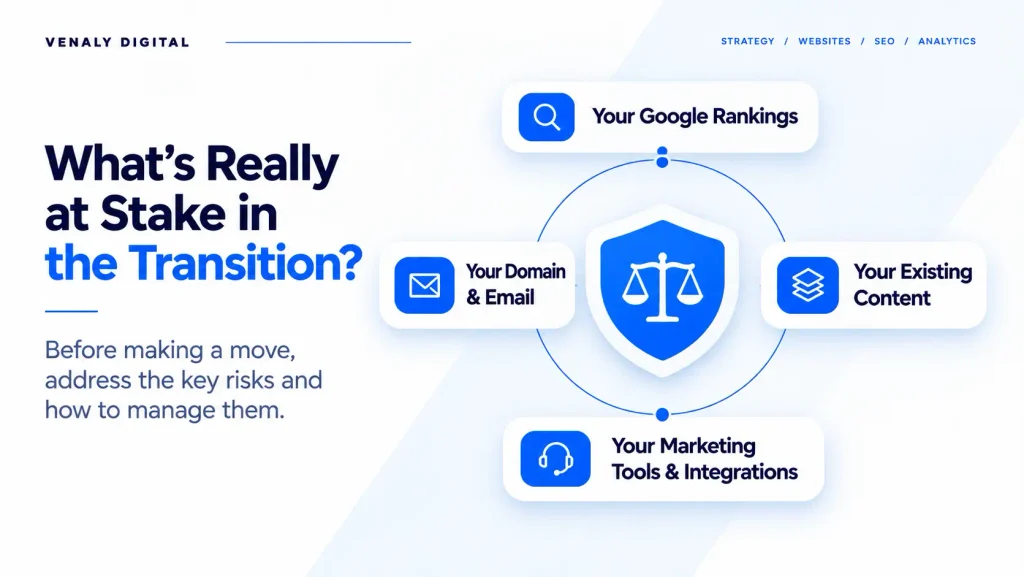
Five Concerns Before Leaving FindLaw
Even when you’re dissatisfied with your current website, changing providers can feel risky.
Those concerns are reasonable. Your firm may depend on the website for inquiries, professional communication, and valuable search traffic.
Here’s what I’d address before committing to a rebuild.
1. Will we lose our Google rankings?
If your website already ranks for searches that attract qualified clients, those positions represent valuable business opportunities.
A new design isn’t worth sacrificing that visibility through a poorly planned transition.
Before rebuilding, I’d expect a developer to review existing search performance, identify important pages, and determine which URLs and content should be preserved.
Major website changes can cause ranking fluctuations. A planned migration reduces avoidable risks, but no provider can guarantee identical rankings.
Protecting existing search value should be part of the project from the beginning, not something addressed after launch.
2. What happens to our domain and professional email?
Changing website providers doesn’t automatically mean changing your domain or email addresses.
But your firm needs to know who controls those services before making changes.
I’d verify the relevant accounts and access, then plan the website transition around keeping business communications operational.
For a law firm, losing access to professional email or client inquiries is a business continuity issue—not a minor technical inconvenience.
3. Can we keep our existing content?
Your attorney biographies, practice-area pages, and articles may represent years of investment.
Some may already attract valuable organic traffic.
FindLaw provides options for obtaining certain website content, but the availability and transferability of individual assets depend on your agreement.
I’d review those materials before deciding what to rebuild.
There’s no reason to discard successful content simply because you’re changing providers.
4. Will we lose our existing marketing tools and integrations?
Not necessarily.
Your website may connect with call tracking, contact forms, analytics, advertising platforms, or client intake systems.
Some services may continue operating after a rebuild. Others may require new configurations, permissions, or replacement.
I wouldn’t recommend changing everything at once.
First identify which tools support your business today. Then determine how they can remain operational during the transition.
The goal is to improve your website without unnecessarily disrupting the systems that help turn inquiries into clients.
5. Will we lose the convenience of having someone manage everything?
You shouldn’t have to.
Some firms appreciate FindLaw precisely because its team handles updates and technical work.
That’s a legitimate benefit, and any alternative needs to account for it.
An independent website doesn’t mean your attorneys must manage WordPress, monitor security, or troubleshoot hosting problems.
You can retain control of the asset while delegating those responsibilities to a professional.
Independence should give your firm more options, not more administrative work.
How to Decide Which FindLaw Alternative Is Right for Your Firm
I wouldn’t recommend switching simply because another provider promises a better-looking website or lower monthly costs.
The decision needs to make sense for your practice.
Start by evaluating your current results.
Does your website attract qualified inquiries? Does it communicate your firm’s experience? Are you satisfied with the support you receive? Can you make the changes your business needs without unnecessary complications?
Then consider where the firm is headed.
If you’re adding attorneys, expanding into new markets, improving your intake process, or investing more seriously in marketing, your website should be able to support those plans.
Here’s how I’d evaluate the alternatives:
Stay with FindLaw if you’re satisfied with its results, appreciate its managed services, and your current arrangement supports your goals.
Consider Justia Elevate if you prefer another legal-specific provider managing your website.
Consider Scorpion if you need broader marketing, advertising, and client acquisition support.
Consider independent custom development if you want stronger branding, practical ownership, and the flexibility to choose your own providers.
For an established firm with an existing reputation, valuable content, and organic visibility, I generally favor evaluating the independent option first.
Not because managed platforms are inherently bad, but because the ability to control and improve your website becomes increasingly valuable as your firm grows.
Consider the cost of staying, too
A website rebuild involves an investment, and the transition deserves careful planning.
But remaining in an arrangement that no longer fits your firm also has a cost.
It may limit how effectively you present your expertise, expand into new areas, introduce better intake processes, or work with different marketing professionals.
The right decision isn’t necessarily the cheapest option today.
It’s the one that gives your firm the strongest foundation for the next several years.
Looking for an Alternative to FindLaw? Start With an Assessment.
If your current website no longer reflects the firm you’ve built, it may be time to consider a different approach.
But before committing to a rebuild, I’d recommend understanding what you already have.
Your existing website may contain valuable pages, established Google visibility, and integrations that support client acquisition. Those assets deserve careful attention.
At Venaly Digital, we help established law firms move from managed website arrangements to independently controlled, custom WordPress websites.
We build the replacement while your existing site remains live, with a migration plan designed to preserve valuable assets and reduce avoidable SEO risks.
Custom law firm website rebuilds includes the first year of hosting and three months of post-launch technical support.
Before making your next website decision, find out what a more independent website could look like for your firm.
We’ll review your current website and provide a preliminary project scope and investment range so you can decide whether rebuilding makes sense.