
Switching website providers isn’t a small decision when your law firm has spent years building its online presence.
Your Justia website may already rank for valuable searches, bring in prospective clients, and contain content you’ve invested in over time. You don’t want to lose that progress.
At the same time, your firm may have outgrown its current website. Perhaps the design no longer reflects your reputation, making changes feels restrictive, or you’re looking for greater control over your online presence.
You’re not simply choosing a new website. You’re making a decision that could shape how your firm attracts clients and grows over the next several years.
I’ll compare three Justia Elevate alternatives worth considering: independent custom website development, FindLaw, and Scorpion. We’ll look at their strengths, limitations, costs, and what each means for your firm’s future.
Justia Elevate Alternatives at a Glance
| Alternative | Best For | Pricing | Main Consideration |
|---|---|---|---|
| Independent Custom Website | Established firms seeking greater control and distinctive branding | From $3,500 at Venaly Digital | Higher upfront investment |
| FindLaw | Firms wanting managed websites and legal marketing | Custom quote | Service scope and contract terms |
| Scorpion | Firms seeking broader marketing and client acquisition services | Custom quote | Ongoing commitments and portability |
Each option serves a different purpose. Before comparing providers, it’s worth identifying what your current arrangement may be holding back.
Why Law Firms Consider Leaving Justia Elevate
Justia Elevate offers a convenient way to maintain a law firm website without managing the technical work yourself.
For many practices, that arrangement works.
But the needs of a growing firm can change significantly.
Your firm’s growth may outpace your website plan
One detail worth examining is Justia Elevate’s lawyer profile limits.
Its published plans include:
| Plan | Included Lawyer Profiles |
|---|---|
| Tier 1 | 1 |
| Tier 2 | 3 |
| Tier 3 | 5 |
| Tier 4 | 12 |
Justia includes unlimited general content pages across these plans, but attorney profiles have separate limits.
If your firm currently has three attorneys and plans to hire a fourth, you’ll need to confirm how your existing plan accommodates that addition.
This doesn’t automatically make Justia a poor choice. However, I believe established firms should consider whether their website arrangement can accommodate future growth without requiring changes to their service plan.
Your website may no longer reflect your reputation
A firm handling complex litigation or high-value cases needs a website that communicates experience, credibility, and professionalism.
That doesn’t require flashy design.
It requires clear positioning, strong attorney profiles, relevant practice-area information, and an experience that makes prospective clients confident about contacting your office.
If your website looks and feels interchangeable with competing firms, you may be missing an opportunity to distinguish your practice.
You want more control over future decisions
Perhaps you want to hire a different SEO consultant, expand into new markets, or change how your firm handles online inquiries.
Those decisions become easier when you have greater control over your website and the providers supporting it.
For me, this is one of the strongest reasons to evaluate alternatives.
The 3 Best Justia Elevate Alternatives for Established Law Firms
Not every Justia alternative solves the same problem.
Some providers offer another fully managed website and marketing service. Others give your firm more control over its website while allowing you to outsource maintenance and support.
The right choice depends on what you’re trying to improve: your firm’s image, marketing performance, operating costs, or long-term flexibility.
Here’s how the three options compare.
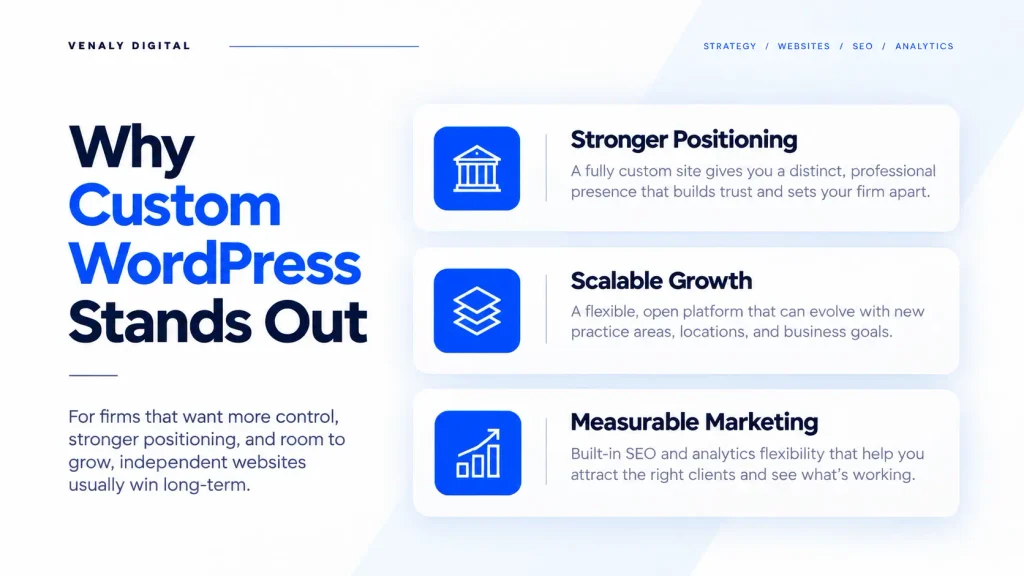
1. Independent Custom Website Development
Best for established law firms seeking stronger branding, greater control, and long-term flexibility.
Rather than moving to another managed website platform, your firm can commission a website developed specifically for its needs.
At Venaly Digital, we use WordPress for these projects. Justia Elevate also uses WordPress, so the distinction isn’t the software itself. It’s how the website is built, managed, and controlled.
A website that represents your practice
Your firm’s website should reflect the type of work you handle, the clients you serve, and the reputation you’ve earned.
A commercial litigation firm shouldn’t necessarily present itself like a personal injury practice.
Custom development gives you greater flexibility over the design, attorney profiles, practice-area organization, and consultation process.
It also allows the project to focus on business results rather than appearance alone.
I wouldn’t recommend replacing valuable content simply to make everything look new. If existing pages attract qualified visitors, preserving and improving them may be the better approach.
Control without becoming your own IT department
One concern I regularly see attorneys express is the responsibility that comes with maintaining an independent website.
They don’t want to manage updates, backups, hosting, or security problems.
And they shouldn’t have to.
Your firm can control its website while a professional handles ongoing maintenance.
The important part is establishing clear ownership and access from the beginning.
I recommend having your firm’s domain, hosting arrangements, website files, and administrative access documented in the development agreement.
That gives you more freedom to change providers later without unnecessarily rebuilding the entire website.
Room to grow without fixed profile tiers
An independently developed website doesn’t need to follow a provider’s predefined limits on attorney profiles.
You can add new attorneys, practice areas, or office locations as your firm expands.
Those additions may still involve development and maintenance costs. But they don’t automatically require moving to another proprietary website subscription tier.
For firms planning to grow, that flexibility can be valuable.
Custom website pricing
At Venaly Digital, custom law firm website rebuilds start at $3,500 as a one-time implementation fee.
That includes the first year of hosting and three months of post-launch technical support.
Hosting, maintenance, and other services after those periods should be defined separately.
The upfront investment is higher than many entry-level website subscriptions. However, an independent website gives you the option to choose who maintains and develops it over time.
My assessment: I’d consider this the strongest fit for an established firm that wants its website to reflect its reputation and support future growth. The trade-off is a larger upfront investment and the need to choose a reliable development and maintenance partner.
2. FindLaw
Best for firms that prefer an established legal marketing provider managing their website and related services.
FindLaw offers website development alongside SEO, content, directory exposure, and other legal marketing services.
Its website programs include Website 100, Website 200, and Website 300, with different levels of service.
Where FindLaw makes sense
FindLaw can be attractive if you want one company handling multiple aspects of your online marketing.
Instead of coordinating designers, content writers, and marketing specialists separately, your firm can work with a provider focused on the legal industry.
That convenience has value, especially for practices without an internal marketing team.
What I’d review before switching
I’d examine the services included in the proposal and how performance will be measured.
More importantly, I’d clarify what happens if your firm decides to leave.
FindLaw states that customers retain rights to their website content when contracts end and can work with their account manager to obtain available materials.
However, having access to content doesn’t necessarily mean the entire website can be transferred without additional development.
Before signing, ask which assets you retain, what can be moved, and what might need rebuilding.
FindLaw pricing
FindLaw doesn’t publish standard prices for its website programs. You’ll need a customized quote.
I recommend requesting the complete cost, including ongoing services, contract length, renewal conditions, and any additional charges.
My assessment: FindLaw makes sense for firms that value having an established legal marketing company handle their website and related services. I’d pay particular attention to what’s included in the monthly agreement, how results are reported, and what happens when the contract ends.
3. Scorpion
Best for firms looking for a broader marketing and client acquisition partner.
Scorpion combines website development with SEO, advertising, reputation management, lead handling, and performance reporting.
Its offering goes beyond maintaining a website.
Where Scorpion can add value
For a law firm investing heavily in marketing, attracting website visitors is only part of the challenge.
The firm also needs to respond to inquiries, evaluate potential cases, schedule consultations, and understand which marketing activities generate clients.
Scorpion offers services addressing several parts of that process.
This can make sense for firms seeking a coordinated marketing operation.
However, if you’re satisfied with your current marketing and primarily want a better website, a broader service arrangement may be unnecessary.
Website portability and contracts
Scorpion states that customers retain assets such as domains, content, and imagery after fulfilling their contracts.
It also provides website files and design assets when customers leave.
However, moving away from its underlying website system may require rebuilding the site elsewhere.
I consider this an important distinction.
Your firm may retain its content while still facing additional development work to operate independently.
Scorpion pricing
Scorpion provides customized pricing.
Its published FAQ indicates that marketing technology and certain services, including SEO, typically require 12-month contracts, while digital advertising services generally have month-to-month terms.
Confirm the specific conditions in your proposal.
My assessment: Scorpion is worth considering when your firm’s needs go beyond website design and include advertising, lead management, and broader marketing operations. I’d evaluate the proposal based on the additional clients those services could generate, rather than the website alone.
What Does Website Ownership Really Mean?
This is one area where I encourage managing partners to look beyond sales presentations.
Website ownership isn’t always as straightforward as it sounds.
Justia states that Elevate customers can request HTML and graphic files, WordPress content exports, and a copy of their custom theme when canceling.
That’s an important distinction: leaving Justia doesn’t automatically mean losing everything you’ve built.
However, receiving website files and having the freedom to operate the website independently aren’t necessarily the same thing.
Before choosing any provider, I’d want to know:
- Who controls the domain, hosting, and administrative accounts?
- Can the website operate with another provider?
- What happens to the design, content, and files if the agreement ends?
- Will changing providers require rebuilding the site?
For an established law firm, ownership should mean practical control over future decisions, not simply access to files when a contract ends.
That’s one of the strongest arguments for an independently developed website with clearly documented ownership and support arrangements.
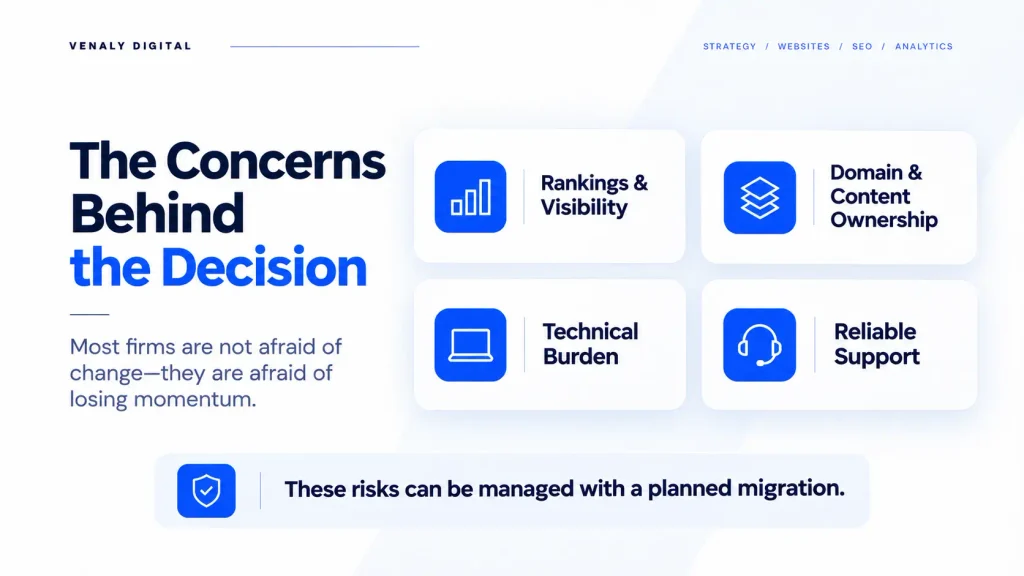
Five Concerns Before Leaving Justia
Even when a firm wants to switch providers, the potential risks can delay the decision.
These concerns are reasonable. They should be addressed before you commit to a rebuild.
1. Will we lose our Google rankings?
If your firm ranks well for valuable searches, you have something worth protecting.
A new design isn’t worth sacrificing years of visibility through a poorly planned transition.
Before rebuilding, I’d expect the developer to review your existing search performance, identify important pages, and document which content and URLs should be preserved.
Google warns that major website changes can cause ranking fluctuations.
A carefully planned migration can reduce avoidable risks, but no provider can guarantee identical rankings after launch.
The migration strategy should be part of the proposal, not an afterthought.
2. What happens to our domain and email?
Changing website providers doesn’t automatically require changing your domain or professional email addresses.
However, your firm should confirm who controls those services before beginning.
A responsible transition includes checking domain access and planning how the website will change without unnecessarily disrupting email or other services.
3. Can we keep our existing content?
Your practice-area pages, attorney biographies, and articles may represent years of investment.
Some may already attract valuable search traffic.
Justia provides content export options, but your new developer should review what’s available and determine what can be preserved.
I wouldn’t recommend rebuilding successful content without a clear reason.
4. Will we need to manage the website ourselves?
No.
Your firm can retain control while a professional handles hosting, security, updates, backups, and technical support.
The goal is greater independence, not additional work for your attorneys.
5. Will we lose the support we’re used to?
Some attorneys appreciate Justia because its team handles updates and responds to requests.
That’s a legitimate benefit.
If you switch, make sure your new provider explains how support works, what’s included, and what ongoing maintenance will cost.
Independence shouldn’t mean being left without assistance.
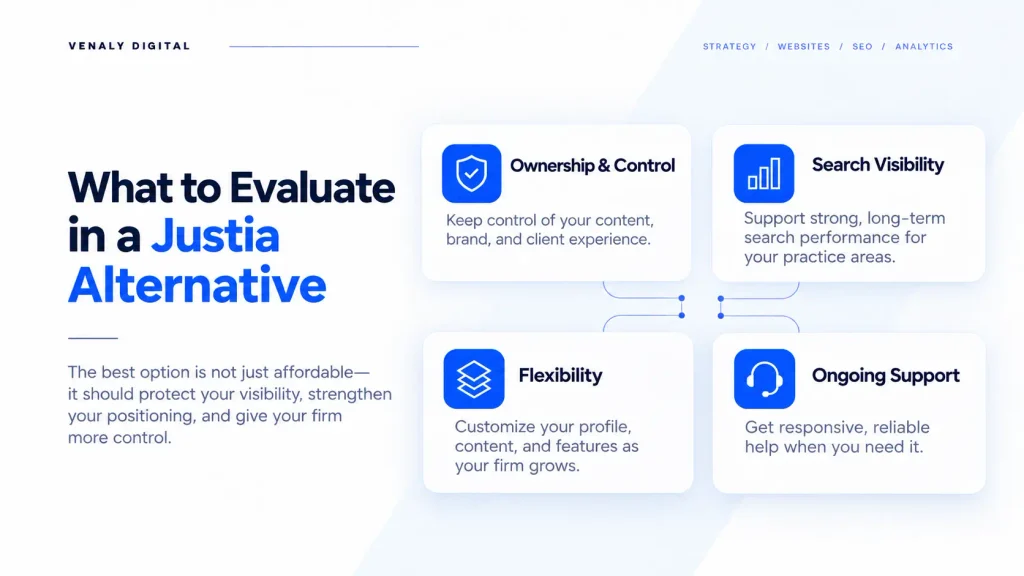
How to Decide Which Justia Alternative Is Right for Your Firm
I wouldn’t recommend switching simply because another provider promises a better-looking website.
The investment needs to make sense for your practice.
Start with your current results. Is your website attracting qualified inquiries? Does it represent your firm’s experience? Can you make the changes your business needs without unnecessary complications?
Then consider where your firm is headed.
If you’re adding attorneys, expanding into new markets, or investing more seriously in marketing, your website should be able to support those plans.
Here’s how I’d approach the options:
Stay with Justia if you’re satisfied with its service, your website performs well, and the current arrangement supports your goals.
Consider FindLaw if you prefer an established legal marketing provider managing your website and related services.
Consider Scorpion if your needs extend into advertising, lead handling, and broader client acquisition support.
Consider independent custom development if you want stronger branding, greater control, and the flexibility to choose your own providers.
For an established firm with existing rankings and valuable content, I generally favor evaluating the independent option first.
Not because managed platforms are inherently bad, but because greater control can become increasingly valuable as your practice grows.
Consider the cost of staying, too
A website rebuild requires an investment, and the transition deserves careful planning.
But remaining with a website arrangement that no longer fits your firm also has a cost.
It may limit how effectively you present your expertise, introduce new services, or work with different marketing professionals.
The right decision isn’t necessarily the cheapest option today. It’s the arrangement that best supports your firm’s next several years.
Looking for an Alternative to Justia? Start With an Assessment.
If your current website no longer reflects the firm you’ve built, it may be time to consider a different approach.
But before committing to a rebuild, I recommend understanding what’s already working.
Your website may have valuable content, existing Google visibility, and pages that regularly attract potential clients. Those assets deserve careful attention.
At Venaly Digital, we help established law firms transition from managed website services to independently managed, custom WordPress websites.
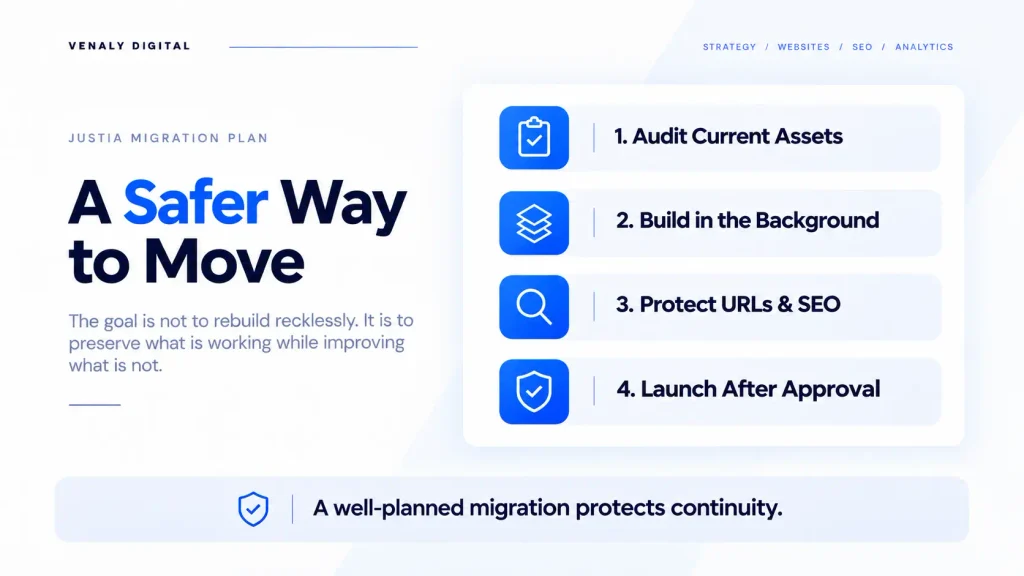
We develop the replacement while the existing website stays live, with a migration plan designed to preserve valuable content and reduce avoidable SEO risks.
Custom law firm website rebuilds start at $3,500, including the first year of hosting and three months of post-launch technical support.
Before making your next website decision, find out what a more independent website could look like for your firm.
Request Your Website Rebuild Assessment
We’ll review your current website and provide a preliminary project scope and investment range so you can decide whether rebuilding makes sense.